Sunday, August 30, 2009

EARTH GIRLS ARE EASY (And Other Deep Thoughts)

EARTH GIRLS ARE EASYEARTH GIRLS ARE EASY (1988)…whoa, Nellie! 1988?! Has it really been over 20 years? Ouch.

I watched this film just one time, right after it first hit home video. As a result, my memory is as fuzzy as the fur on the aliens in that flick. At the time, I felt obligated to see it as an SF fan, more so than from any real interest. I recall it as a roller coaster of sexy, campy fun, and to the film’s credit, it didn’t aspire to anything more. (What do you expect from something based on a Julie Brown song—80s high-concept or a New Wave MACBETH?)

For the uninitiated, the basic plot doesn't exactly aspire to rival Lars von Trier: “A spaceship with three furry aliens lands in a California girl's swimming pool, so she makes friends with them.”

Yep, that pretty much covers it.


Now when it comes to films like EARTH GIRLS ARE EASY, you either go along for the ride or just fuhgetaboutit. There’s almost nothing to poke fun at because the film pokes fun at itself. It’s almost pointless to criticize such lowbrow fare—no matter how titillating the neon pop of late 80s fashion, but regardless, I did have one beef with EGAE:

The aliens, Mac (Jeff Goldblum), Wiploc (Jim Carrey), and Zeebo (Daman Wayans) were only deemed attractive after stylist Candy (Julie Brown) removed their fur. It bothered me when I first watched the film, and a story I’ve been reading reminded me of it again.

But I must detour for a moment to gush over Jeff Goldblum. He was hot, hot HOT in this film. Volcanically hot. The man is an Adonis. The shallow side of me cheered in full pom-pom mode at the unveiling of his luscious bod. Let’s feast our eyes for a moment:
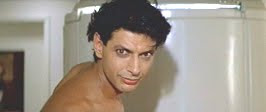
Jeff Goldblum Earth Girls


Okay, that was lovely, but now back to our show. At the risk of reading too much into EARTH GIRLS ARE EASY, it seems as though the homogenization & humanization of the three aliens symbolizes our deep-seated fear of the alien “other.” The film is a comedy yet it openly (but not deeply) explored that issue. The film tells us that bonding with a humanoid alien is kosher as long as they look exactly like us. For all we know, they had pink-colored blood or three hearts, but what mattered most was their outward appearance.

(As an aside, I heard that the Fox studio suits asked James Cameron to tone down the aliens in AVATAR in order to make them appear more human. Needless to say, Cameron won that particular battle. Thank goodness.)

On a related note, earlier this year I read Ann Somerville’s e-novella ON WINGS, RISING and I’m currently reading REACHING HIGHER. Both m/m stories are sensitive explorations of falling in love with an alien although I hesitate to even describe the characters with such a loaded term since the Angels are actually a race of telepathic winged humanoids. And yes, they have fur. Back, Candy, back!

Unlike the goofy, 4th grader rendering of otherworldly beings in EARTH GIRLS ARE EASY, Ms. Somerville takes the idea of interspecies love dead seriously. The portrayal is quite tender, and her detailed prose celebrates the Angels’ fierce beauty as well as their otherness. They become as seductive for the reader as they are to the human characters. Given the realism in these stories, it’d be horrifying to think about stripping these characters of their fur or molding them to some narcissistic version of ourselves.

EARTH GIRLS ARE EASY and the work of Ann Somerville represent two vastly different ways science fiction romance can depict interspecies love. Both show it can be done convincingly, albeit along wildly divergent paths.

What the film and Ms. Somerville’s stories also address is the issue of what constitutes attractiveness in a mate for the characters. I can wax poetic about Mac’s handsomeness but at the same time, I must question the assumption that his furred appearance is less beautiful than his non-furred state. Yet the “Earth Girls” found them attractive without fur so I have to accept that. It’s not a big stretch since the movie taps into my cultural expectations.

On the other hand, in a story such as ON WINGS, RISING, the author challenged me to put aside my sense of ideal beauty and suspend my disbelief regarding what the hero/hero thinks is ideal. Because it’s his romance, after all.

Joyfully yours,

Heather
Saturday, August 29, 2009

Stories in Purgatory

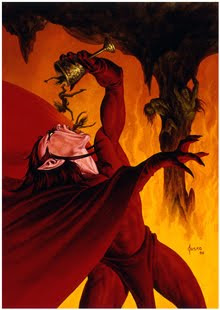
MephistoClose to three years ago, I read an unpublished manuscript written by a friend I met through an online writing community. It had a fantastic premise and was loads of fun. A publisher would probably consider it YA, but I consider it YA SFR. Lots of comic-book style action, a sweet romance, and a unique coming-of-age tale.

My friend eventually landed an agent, albeit with another manuscript. The agent, however, agreed to take a look at her YA manuscript. I helped out with another read to provide feedback before it went on submission. I’ve probably read the story maybe three times now, and it still felt fresh and fun. We were both excited at the prospect of her selling this project. I just knew the cover was going to be fabulous. I was looking forward to featuring the book at The Galaxy Express.

But then the unthinkable happened.

My friend had to fire her agent. The agent stopped returning emails, and obviously lost interest in not only this YA project but also the other manuscripts she’d been submitting. Now my friend will have to start looking for an agent all over again (the first round took her over ten years). What’s frustrating is that she’s a prolific writer who is open to revisions. I lost track of how many she did for her former agent.

I’m really in a funk over it. But not just that. About two years ago, I read part of a rough draft of a romance for another writer friend, and even in its nascent form, the writing and story popped. She moved on from that story, but wrote others. Earlier this week, I learned that one of them was turned down by a publisher whose style and preferences she had carefully studied. Okay, so that’s the nature of the biz, but it still stinks.

On top of that, another friend, a screenwriter, came "thisclose" a couple weeks ago to landing several million dollars to fund the production of a script he had written. I’d read it—and also loved it (trust me, it's good and commercial!). Then the funding all fell through at the last minute. To be clear: my friend would not have made a million dollars. Far from it. But it would have been a very healthy amount and the start to a promising career.

Yeah, it’d be fair to say that in all of these cases I’m biased, but I can’t see any compelling reason that these projects couldn’t be published/produced. This doesn’t even count the SFR stories I know of that have yet to find a home. It’s on my mind since all of the above happened within weeks of each other.

I haven’t stopped to analyze the issue completely, but for years I’ve gone through spells where I mourn the books I may never get to read, or the films/TV shows I’ll never get to watch. Or there are stories that make me go, “I wish I could read/watch more of that.” I should never say never, but on the other hand, reality is reality.

This isn’t to say that I’m not grateful for all the wonderful books/movies already in existence. In fact, I’ve got a nice fat list of books I’m getting ready to purchase, and my DVD collection is overflowing. And goodness knows, there are more important things to worry about.

At any rate, the most frustrating aspect is to have knowledge of projects that are full of promise, and yet all I can do is watch in vain as they hit a brick wall. Then I get cranky thinking about the risk factors in the publishing and film industries and how that creates a barrier between me and my entertainment.

On the bright side, all of the writers mentioned above are the persevering types. I’m going to stay positive and predict that within the next few years, I will be able to not just blog about their success, but shout it out to the stars.

Joyfully yours,

Heather

Thursday, August 27, 2009

The Romance Heroine is Not a Side Dish

Regarding Love Romance Passion’s recent post, 6 Reasons Why the Paranormal Character is Always Male, I was intrigued by Keira's reason #2:

“Strong powerful hero + average heroine = swoon. When an extraordinary specimen of the male gender sits up and takes notice of a rather ordinary female it is easier to place ourselves in the heroine’s shoes. That’s not because we think of ourselves as unworthy, this formula just makes it more accessible for readers. This scenario also tends to fill the tenderness and protectiveness side of the fantasy.”

Keira's explanation prompted a lot of reflection on my part. I appreciate her break down because it, along with other online discussions I’ve seen, clarifies what the romance heroine means for many readers: that of blank template so the reader can imagine herself as the heroine.

I’m no exception to this function as I’ve read romances where the heroine becomes all but invisible, and I process the story in terms of what it’d be like to interact with the hero on the page before me. I’m referring to stories where the character development is clearly skewed in favor of the hero (because if a heroine is “average” or “ordinary,” what is there to develop?).

Frankly, I’m torn about this issue. I can understand the appeal, but on the other hand, I think it does a great disservice to heroines that otherwise might have been portrayed with a lot more personality and depth.


I think this “average heroine” template works better in some genres than in others. I can easily slip into the fantasy if I’m reading a paranormal or historical romance. Not so much if I’m reading science fiction romance or romantic suspense. In fact, my expectation for SFR is that the heroine is going to be just as flashy and filling as the hero, if not more so in some stories.

I certainly appreciate the challenge of rendering both an extraordinary hero and extraordinary heroine with equal measure. How does one compete with a suave vampire or glamorous space pirate heroine? The hero and heroine shouldn’t necessarily be competing with each other for the reader’s attention—or should they?

To be clear, I have a preference for heroines in SFR to have the “special” qualities, or at least special qualities that rival those of the heroes. I love anti-heroines, for example. I’m excited about the endless possibilities for heroines in SFR. Quite frankly, I don’t want them to be average heroines. I want to experience the heroine’s adventures along with her; I don’t want to be her. I envision these heroines as a living, breathing person—someone separate from me, not an excuse for me to fantasize about falling in love with a dashing starship captain.

I recently finished Susan Kearney’s THE QUEST and the heroine is the captain of her own salvage ship. Boo-yah! The hero’s special quality was his psi ability. Both had something unique, strong, and powerful to bring to the relationship, and neither overshadowed the other (though I ultimately thought it was the heroine’s arc that stood out).

Many recent SFR heroines are exceptional and so perhaps my fear is that the trend won’t continue, or that it will fall victim to marketing departments that are only interested in pimping selling the "blank template heroine" to readers. I admit I have trouble relating to the desire for this fantasy in book after book after book, even as I’ve slipped into that mindset in the past.

I just want to feel as passionate about the heroines as the heroes…is that so wrong?

Joyfully yours,

Heather

Tuesday, August 25, 2009

Of Robots, Androids, and Cyborgs...

A recent exchange with TGE passenger BevBB (Bev’s Books) made me realize that I was overdue for a post about robots, androids and cyborgs—namely, a handy guide to these wonders of futuristic engineering.

Immersed as I’ve been in the culture of SF, I sometimes forget how perplexing many of the genre’s tropes can appear to the uninitiated. Therefore, I reasoned that readers new to science fiction romance might have an easier time with the learning curve if there are references available.


Astro Boy


With that in mind, I compiled basic information about robots, androids, and cyborgs. These kinds of characters are pretty ubiquitous in SF/SFR, but the distinctions between them can get pretty complicated.

Here’s the lowdown:

Robot—“…an electro-mechanical machine which is guided by computer or electronic programming.”

Droid—“Droids are robots seen in STAR WARS, DOCTOR WHO, and BEN 10 and is a registered trademark of Lucasfilm Ltd.”

Android—“An android is a robot or synthetic organism designed to look and act like a human.”

Cyborg/biomechanoid—A being who is a “synthesis of organic and synthetic parts.”

Roy Batty


Replicant—“…a bioengineered or biorobotic being created in the film BLADE RUNNER (1982).”

Automaton—steampunk robot or android. Automatons are powered by steam, electricity, or clockwork mechanisms. (Did you know…the term "android" appears in US patents as early as 1863 in reference to miniature humanlike toy automations? Holy rivets & dirigibles, Batman! If that’s not a steampunk romance in the making, I don’t know what is!!)

In science fiction, “Authors have used the term android in more diverse ways than robot or cyborg. In some fictional works, the difference between a robot and android is only their appearance, with androids being made to look like humans on the outside but with robot-like internal mechanics. In other stories, authors have used the word 'android' to mean a wholly organic, yet artificial, creation. Other fictional depictions of androids fall somewhere in between."

Another factor related to the nature of robots, androids, and cyborgs is that of artificial intelligence. Science fiction associates…AI with such human traits as consciousness, sentience, sapience and self-awareness. There are loads of stories about androids evolving to the point of sentience, usually involving an exploration of the consequences/implications.

Frequently—and confusingly—a robot or android character seems to be sentient, but it’s actually an anthropomorphic device in play. Sometimes this device is used to good effect; other times it’s just annoying (case in point: Twiki from BUCK ROGERS IN THE 25TH CENTURY, Rosie the maid from THE JETSONS,Vicki from SMALL WONDER).

Below is a sampling of who’s what from some popular SF shows and films:

Metropolis


Maria (METROPOLIS (1927))—robot

Annihilants (FLASH GORDON)—robots

Data (STAR TREK: THE NEXT GENERATION)—android

Borg Queen


The Borg (STAR TREK: TNG)—cyborgs

R2D2 & C-3PO (STAR WARS)—robots

Analyzer (SPACE BATTLESHIP YAMATO)—robot

Cylons (BATTLESTAR GALACTICA)—

“The Cylons of the 1978/1980 series are…an advanced reptilian race who created the robots (who were referred to as Cylons within the show) to serve them, maintain their vast empire and to man their military forces in the face of a sudden population drop that eventually led to the Cylons' extinction…”

In the updated [2003] version, the Cylons were created by humans as cybernetic workers and soldiers…the reimagined series includes twelve Cylon models that are nearly indistinguishable from human beings…Much of the Cylons' technology is based heavily on bioengineering and/or synthetic biology rather than conventional robotics.

Daleks

Daleks (DOCTOR WHO)—“…organisms from the planet Skaro, integrated within a tank-like mechanical casing.

Bishop (ALIENS)—android

The above is barely the tip of the robotic iceberg.

For a handy big-ass reference, you can also check out Wikipedia’s comprehensive list of fictional robots and androids. Warning: it’s highly addictive.

If you’re hungry to taste some android/cyborg lovin’ right now, check out Catherine Asaro’s SUNRISE ALLEY and its sequel, ALPHA, Linnea Sinclair’s GAMES OF COMMAND, and Tanith Lee’s SILVER METAL LOVER. (Special mention: Susan Kearney’s THE QUEST includes biomechanoid villains!)

Joyfully yours,

Heather

Monday, August 24, 2009

The Coming eBook Explosion [Updated 8-25]

Sony ereaderThe CleanTech Group recently announced their projections on the carbon footprint of electronic books vs. regular “treeware” paperbacks. Coming as no surprise, the eBook readers win out here (danke to MobileRead for the heads up).

But that’s not the purpose of this post.

They also announced a slew of statistics that I found interesting—namely how many units have been sold in the U.S. and the projected sales in the next years. In short, they expect a lot of people out there to join the ebook revolution. A lot.

If these projections turn out to be only half right, this could dramatically boost niche genres like science fiction romance.

How many have been sold to date? CleanTech states:

e-readers are still a niche technology, with a little more than 1 million units sold to date.

Slightly over one million…? Not bad for this nascent tech, especially when you factor in the extended economic gloom we’ve experienced. So what about the Kindle…?

Amazon typically holds its cards close to its chest, refusing to release concrete sales numbers of its device even to shareholders. But according to CleanTech:

In the United States, Amazon currently holds a 45 percent market share of e-reader devices, with one main competitor Sony trailing at 30 percent.

Hmm, Amazon is fighting hard to “own the brand” of eBooks, and they’re clearly winning that battle to some degree. Many people now refer to every standalone ereader device as a “Kindle”—be it a Sony Portable Reader, iRex iLiad, or Bookeen Cybook. (It’s the same with every MP3 player being an “iPod,” regardless of whether it’s from Apple or not.)

Okay, this is all fine and interesting. But here comes the article’s real revelation:

Continuing in the CleanTech report, they also postulate that combined eBook hardware sales could reach up “to 14.4 million in 2012” [emphasis mine].

14.4 million eBook readers sold! Hmm, now achieving that number in a little over three years does sound a little optimistic to me. But even if that figure only conservatively climbs to ~65% of that by 2012, we can still expect to see slew of new eBook devices out in the hands of readers.

And new hardware demands new software—or in this case, new ebooks.

Headless EyesYou see where I’m going with this. Just how the VHS explosion in the mid-80s drove every wacky movie ever made to store shelves—just because new VCR owners needed food for their machines—this technology could provide just the tipping point SFR needs.

What are your thoughts on this? If HEADLESS EYES (yes, this is a real movie) can see a release through the late, lamented Wizard Video (with their extra large VHS boxes and gory as hecka-heck cover art), shouldn’t we expect mainstream SFR stories to start popping up more and more?

And speaking of....

Looking for a home for your manuscript? Quartet Press wants your SFR! The newest romance epublisher is launching a sub-imprint devoted to “…fantasy/science fiction/urban fantasy with romantic elements” according to editorial director Angela James. Ms. James also stated that “We’ll be targeting some extra marketing efforts at these sub-imprints as we get going because I think there’s a place for both in the digital world.”

Also, Red Sage is seeking novel-length manuscripts and will consider SFR. Editor Sasha Knight of Samhain recently tweeted that she’s looking for more futuristic romances to build her list.

Hmm, I think we’re onto something here! Thoughts…?

Joyfully yours,

Heather

UPDATE: Sony has just announced three new Readers today. One has 3G wireless capabilities and allows you to check out ebooks through local libraries. At $400, that model is definitely pricey, but a cool concept in motion nonetheless. You can read all about the new editions here.