New Releases STEAMED – Katie MacAlister
Jack Fletcher's heart is about to get punked.
Computer technician Jack Fletcher is no hero, despite his unwelcome reputation as one. In fact, he's just been the victim of bizarre circumstances. Like now. His sister happens to disturb one of his nanoelectromechanical system experiments, and now they aren't where they're supposed to be. In fact, they're not sure where they are when…
…they wake up to see a woman with the reddest hair Jack has ever seen-and a gun. Octavia Pye is an Aerocorps captain with a whole lot of secrets, and she's not about to see her maiden voyage ruined by stowaways. But the sparks flying between her and Jack just may cause her airship to combust and ignite a passion that will forever change the world as she knows it…  CYBOT AWAKENED – Melisse Aires
Sabralia lives a lonely but luxurious life in Emperor Sirn’s Harem, her only companion is her obedient servant, Qy, a cybot. Her life has largely been controlled by others, but when Sirn demands his Harem pleasure his Commanding Officers at a victory celebration, Sabralia makes a daring plan to hide to avoid rape by Sirn's men. The Palace is ambushed and her cybot gets her off world. The impossible has happened−Qy the gentle cybot becomes the man he once was, the warrior Kaistril. Pursued for valuable information, Sabralia is thrust into dangerous, unfamiliar situations where she must stand up to the challenges, or lose the man she loves.
EMBRACE THE NIGHT – Joss Ware
Everything they knew is gone.
From the raging fires, five men emerge with extraordinary new powers. They must learn how to survive this dark, ravaged world ... but they cannot do it alone.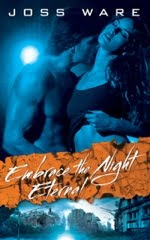 Simon Japp will never forget his violent past. But when civilization is all but destroyed, he sees his chance for redemption. Blessed with a strange "gift," he's determined to help the resistance against the Strangers, the mysterious force that stalks them at every turn. He can't afford to get distracted, even by the stunning, soft-spoken woman fighting by his side...
Sage Corrigan has learned to be careful where she places her trust. But she sees something good in Simon, even if he can't see it in himself. Posing as lovers to infiltrate a group key to their fight, they find that their staged affection soon develops into a desire that will leave them fighting for their lives in the night eternal...
IMPULSE POWER, Samhain Publishing Space Opera Anthology:
THE MYTHMAKERS – Robert Appleton
METAL REIGN – Nathalie Gray
HEARTS AND MINDS by J.C. Hay
To learn more about Samhain’s anthology stories, click here.
Also out from Samhain this month, HIGH OCTANE by Kathleen Scott:
Two hearts are never more than one dimension apart.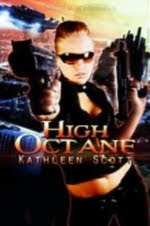 A routine fuel run through one of the planet’s dimensional portals explodes in violence when Major Geneieve Lockhart’s Jumper team is hammered with an unprovoked attack. With her ship disabled and contact to mission control limited, Genie faces her worst nightmare—losing her crew on the blood-soaked floor of a foreign desert.
Help comes from an unlicensed freelance mercenary ship, piloted by a man she never thought she’d see again. Her AWOL ex-lover, Lt. Col. Dante Bowen.
Bowen knows answering Genie’s distress call puts his undercover mission to expose a governmental conspiracy at risk. But after faking his death six years ago, he owes her something. Ending up chained in her cargo hold for transport to his own court martial wasn’t the thanks-for-the-rescue he expected.
The bridges between them may be in ashes, but their desire burns as hot as ever. Even as Genie wonders what happened to Bowen’s code of honor, her body betrays her heart at every turn. The hostile race that attacked her ship, though, is coming back to finish them off. The only way to ensure freedom—on both sides of the dimensional divide—is to put her trust in the one man who betrayed it…
Warning: Contains action-packed dimensional travel, hot military wartime sex, betrayed lovers and evil, power-hungry bastards.
Whew, and I'm just getting started!
Author News, Posts, & Interviews
Embrace the Shadows presents an interview with Robin D. Owens.
Ann Aguirre unveils the cover for KILLBOX:
Kick back with a big mug of space java and a thick notepad for Religion in Science Fiction Romance by Jacqueline Lichtenberg
Sarah A. Hoyt (DARKSHIP THIEVES) guest blogs at SFSignal: The Death of Science Fiction: It Ain’t Over Til The Fat Droid Sings. She speculates on why young folks seem to be aversive to reading science fiction. Here’s an excerpt that I think has relevance for science fiction romance: There will always be a place where science is utterly proven and can be extrapolated along safe, almost sure lines - and that's fine. But it doesn't leave much place where people can dream. And people need to dream… I'm not saying that space opera and "looser" (softer usually means message-oriented) sf don't exist - Kevin J. Anderson and Lois McMaster Bujold, David Weber and indeed any number of writers from Baen give this the lie. I'm saying it is neither as loose as in media, nor is there nearly as much of it as there should/could be. We're not only not going for all the market can bear, we're not touching the market out there.
Jess Granger posts chapter 25 of her *free* science fiction romance adventure ETHEL THE SPACE PIRATE!
Publisher news
Red Sage Publishing has a new look!
Listen in on the Carina Press Podcast with Angela James and Malle Vallik
Skiffy Rommer Fun
Discover if SFR by authors Angela Knight, Gena Showalter, and Deirdre Knight are for you courtesy of two posts at Spacefreighters’ Lounge: In Search of New Reads, Part I & Part II
Ella Drake (FIRESTORM ON E-TERRA)shares 13 things she enjoyed about Sarah A. Hoyt’s DARKSHIP THIEVES
Stuck for a title for your steampunk romance? Lisa Paitz Spindler brings on the Steampunk Manifesto Title Generator
This ‘n that
Two neat posts from Blog, Schmog: Linnea Sinclair: Romantic SF is not a contradiction in terms & The SciFi Military Paradigm (in which proprietor Bart addresses the question, “Why is the Navy the model for Science Fiction military, not the Air Force ?”).
Check out some kewl and little known facts about Superman’s main squeeze in Lois Lane, Super Heroine, Role Model, or…Sex Symbol? (via Bev’s Books)
In The Female Action Hero, Fantasy & SciFi Lovin’ News & Reviews asks, “But were these women really tough or merely ornamental?” (It’s an older post but totally worth visiting just for the smokin’ hot image of Sigourney Weaver from ALIEN)
Edited to add: So you can more easily look up information on new releases by year, I started a list on the right sidebar under "SFR Specials" for links to the new release roundup posts. Also, I added more authors to the left hand column under the "2010" heading, so check 'em out!
Got any hot science fiction romance news to share? Comment away!
Joyfully yours,
Heather
Saturday, January 30, 2010
SFR Linkfest for February, 2010
A Publishing Industry War Is Brewing: Amazon Vs. MacMillan
A big ugly storm is raging between Amazon and MacMillan. At stake are sales for MacMillan authors and readers' access to books.
Here are links to coverage of this dismaying turn of events:
Game On: Amazon Removes the Buy Button for All MacMillan Books
MacMillan Pens Open Letter to Authors and Agents
It's All About Timing (Thanks to Mary F. for the link.)
Who's the Bully Here? (Jackie Kessler rounded up a number of links on the subject.)
Joyfully yours,
Heather
Thursday, January 28, 2010
I’m In Love With A Traumatized Hero!
 Hey Ho, Esteemed Passengers of The Galaxy Express. It’s been too long since I hitched a ride on this fine vessel. I was sent on a dangerous mission to the Triangulum Galaxy and, well, to cut a long story short—thanks for bailing me out, Heather!!
After missions, I usually return to my home base to be met by the pile of luverly books I had ordered before I left, and this time was no exception. I’d been through some traumatic events so I needed something really wonderful to distract me. Enter C.J Cherryh’s MERCHANTER'S LUCK.


The gal on the cover is Allison Reilly of the mighty starship, Dublin Again. She’s a great character, but Allison is not what has me all a-tingle. No, the truth is I’ve gone and fallen in love with the hero of this book, Sandor Kreja. Oh, my aching heart!
Sandor is a very different kind of hero. He’s not wealthy or powerful or strong or glamorous. In fact, when the reader first meets him, he is malnourished, in debt, scared and desperate. His first glimpse of Allison is the most happiness he’s known in a long, long time. He offers to buy her a drink, even though he’s broke. They spend the night together. She ships out the next day, so what does Sandor do? He takes off after her. In a broken down ship, with no crew, through solo jump after jump after jump, strapped into his chair with a pulsar unit to keep him awake, with food and water taped within reaching distance, alone except for the memories of that terrible day when his life and his psyche had been blown into a million shards. It’s an act of suicide. He’s attempting the impossible and putting his life in the hands of fate, all for one last chance, one impossible chance at love. How do you like them stakes?
I won’t offer any more spoilers. Suffice to say it’s a wonderful story, with loads of action, fascinating characters and all ilk of spaceships, villains and plot twists. If you’ve tried Cherryh before, and found her work too dense or wordy, then this book will change your mind. Her writing in this is as lean as Sandor’s emaciated body, while still as strong and graceful as Allison’s.
As much as I love C.J. Cherryh, it’s Sandor who is my main obsession at the moment. I’m normally not much attracted to victims, but there was something about Sandor’s mixture of pain, vulnerability and hope that completely hooked me. He’s been through so much trauma that all I want to do is heal him—in any way I can. It’s not the motherly, nurturing type of healing I’m talking about, or maybe it is? I am confused by my reaction to this character.
What are your thoughts, fellow travelers, on the traumatized hero? Discuss amongst yourselves. I’ll be in my bunk—with Sandor.
Be seeing ya!
Agent Z.
Tuesday, January 26, 2010
Tortured Heroes Vs. Villains
Got another issue for us to tangle with based on my reading of DANGEROUS MEN & ADVENTUROUS WOMEN (1992, edited by Jayne Ann Krentz) (the previous post is here). Another aspect that intrigued me centered on the authors’ revelation that one popular execution of a romance hero was to make him part hero, part villain. According to the various essays, this type of tortured hero starts off as a brooding, isolative, even dislikeable character, but learns to tap into his heroic side as a result of the heroine’s interventions.
I began reflecting on how the presence of a tortured hero (or heroine) might impact the presence of villains in science fiction romance. I’ve blogged about villains in this subgenre previously, but was still scratching my head over why they often get such short thrift. Now I think I’m beginning to understand why.
I recall encountering one SFR villain whose physical presence came across as so intangible and distant that I realized the author had made a decision at some point—perhaps unconsciously—that he/they/it was hardly germane to the story. But the hero—ah, he had all the makings of a great villain. So tortured and broody. Sardonic. Dangerous. I mean, it was no contest. What’s a villain to do?
After I finished DANGEROUS MEN & ADVENTUROUS WOMEN, I wondered if the devotion to the tortured, hybrid hero-villain decreased the chances of authors constructing villains who are equally compelling. If all the creative energy is going into the hero, what’s left for the villain? It makes sense, too, because having two tortured male characters would create redundancy. They’d end up canceling each other out.
Villains are a staple of science fiction stories, and I expect to encounter them in SFR on a fairly regular basis. I don’t want them to overshadow the romance, but a well-crafted villain introduces tension and raises the stakes for our protagonists. Now that I think about it, an example of how a villain can be balanced with the romance and science fictional elements is COUNTDOWN. Author Michelle Maddox incorporated her villain into the story in such a way that I had a good taste of him (!) without feeling that he stole the show.
If tortured heroes are sapping all the energy away from villains, how can authors address this imbalance? One way, of course, is to create a compelling “good guy” hero who squares off against the typical tortured villain. Not goody-two shoes, necessarily, more like strong but complicated. But what if the story demands a tortured hero?
Perhaps it’s the villain who needs reinventing. This could be done either in terms of the villain’s personality (e.g., disarmingly charming), or in the type of villain that’s created. I can overlook and even appreciate a two-dimensional villain IF he/she/it is cleverly constructed, executes at least one heinously villainous act during the story (shown, not told), or arrives in an unexpected form. Villains don't always have to be human. They could be mechanical in nature, or environmental.
Tortured heroes probably aren’t the only reason villains in science fiction romance aren’t fully developed in some stories, but I’m wondering if they’ve been a significant factor.
What do you think? If we change the way in which we envision them, what type of villain would be a good match for a tortured hero or heroine?
Joyfully yours,
Heather
Sunday, January 24, 2010
Romance Heroines of the Future
 Some of you may remember a previous post in which I discussed the appeal of the subversive heroine. Upon further reflection, I realized I hadn’t fully processed nor articulated my thoughts on the issue of heroines in science fiction romance and my expectations for them.
Hence, more questions arose, the main one being, will we ever see a fundamental shift in one of the dominant conceptual elements in romance—specifically, the pairing of a dark, dangerous (Alpha) hero and innocent heroine?
Given that the innocent heroine frequently has a reputation for being thinly crafted (in other words, the hero comes across as much more compelling), what does this historical pattern imply for science fiction romance? Will authors and readers ever embrace other templates—on a regular basis—when it comes to SFR?
With those questions in mind, I went exploring.
First stop: Bev’s Books, which featured posts about the issue from the perspectives of The Old “Placeholder Heroine” Myth and Placeholders and the Dual Perspective. After reading her discussions, I still had more questions, so Bev turned me on to DANGEROUS MEN & ADVENTUROUS WOMEN (1992), a collection of essays about the appeal of romance by a group of romance authors and edited by Jayne Ann Krentz. I read the book and pieces of the puzzle began falling into place.
A main point authors in this book reiterated throughout was the belief that, in essence, romances are about dangerous heroes and the heroines who tame them (hero basically defined as a man who is part hero, part villain. Heroine basically defined as sweet/innocent/pure/courageous). I realize much has changed since then (and am aware that the essays could not address the appeal of every single type of romance in existence), but there’s also the saying, “The more things change, the more they stay the same.”
I want to zero in on the role of the heroine. In Laura Kinsale’s essay, she refers to “placeholding” as “an objective involvement; the reader rides along with the character, having the same experiences, but accepting or rejecting the character’s actions, words, and emotions on the basis of her personal yardstick…When the writer does fail with the heroine, however, it is quite easy for the reader to disassociate herself from the character and continue to derive pleasure from the story by using the heroine as placeholder.”
Fast forward eighteen years later: In a comment responding to Bev’s Books’ placeholder post, Kinsale states“in my essay I used the term placeholder to describe a FAILED heroine in a romance–ie, a heroine that the reader did NOT find admirable or interesting, who was Too Stupid To Live, and yet the reader keeps reading and even enjoys the book. My question there was WHY, and my answer was the sense that the reader could ride along with that character and think about how she herself would act in the failed heroine’s place.
I said in my essay that in a successful romance the reader will strongly identify with BOTH the hero and heroine.”
For the purpose of this post, I’m going with Kinsale’s failed heroine definition of a “placeholder heroine.” To piggyback on her statement, I believe the basic core of a romance is the relationship, not simply the heroine’s courageous ability to tame the hero. To me, that seems like only one way of executing a romance. I feel it’s important to emphasize this now because even though DANGEROUS MEN & ADVENTUROUS WOMEN was released in 1992, the beliefs therein are reflected in current books (especially paranormal romance) as well as beliefs about the market. For example, Mary Jo Putney writes:It is much rarer to see the heroine saved by the love of a good man. It is possible to write a romance where the heroine is more tortured than the hero, and I have done so, but it is more difficult and probably less “romantic.” To make a tortured-heroine romance successful, the hero must be a compelling figure in his own right, not a passive foil for the heroine’s problems. While he is supportive and understanding, he must have a role beyond drying her tears or the story fails as a romance.”(p. 101)
So we have two possible scenarios—one with a failed heroine and one with a failed hero. Both can happen. More importantly, both can be avoided (easier said than done, to be sure). Readers can identify with heroes and heroines in stories simultaneously. But even if most authors and readers agree that a successful romance involves both a well-crafted hero and heroine regardless of who is taming whom, why is there such a preponderance of the dangerous hero-innocent-heroine dynamic? I take extreme issue with the belief (not with Mary Jo Putney!) that tortured heroines make for “less romantic” stories. Especially since Catherine Asaro’s heroine Alpha from the book of the same name is one of my favorite tortured heroines. ALPHA was utterly romantic. Imho, the hero of the book was highly compelling and he was far from Hanky Boy Sidekick. Given the rise of urban fantasy, with its signature tortured protagonist who is frequently female, it seems to me UF answered the call from readers ready to evolve beyond the failed heroines of yore (many of which seem to fall into the innocent/Too Stupid To Live category).
I question why we don’t see more tortured heroines, and I have a high expectation to encounter them in science fiction romance. Here’s what appeals to me: tortured heroines with character arcs that demonstrate their willingness to embrace their capacity for love and nurturing—whatever form that love or nurturing might take. In the future, this could entail the heroine leading a military space fleet against invaders in order to save the hero. Said action would not emasculate the hero. At all. Rather, it makes the heroine That. Much. Cooler. I find the above scenario just as romantic as one in which the hero rescues the heroine. And the heroine doesn’t even have to be tortured. Just lose the innocence, because I’m not sure I buy its existence in the future (unless the story truly calls for it, in which case the author has some serious ‘splainin' to do).
As long as the tortured, dangerous heroine is a sympathetic character, undergoes the same emotional transformation expected of her hero counterpart, demonstrates growth, and finds redemption, there’s no reason readers can’t accept such a character on a regular basis. Why they don’t probably has more to do with individual reading preferences, cultural dynamics, and the marketing of romance than the stories themselves.
To belabor the obvious, many SFR characters live in the future. There’s the rub. Perhaps one reason science fiction romance has had a challenging time discovering the sweet spot that would engender wider appeal is its progressive ideas (or at least the potential for them). I, for one, like to assume that in the SFR I read, a variety of social, political, and most of all technological changes will lead to a future in which women can more easily compete with men, protect themselves from male predators, and enjoy a higher level of equality than currently. In other words, it’s difficult to create a convincing case for a virgin heroine and/or the sheltered innocence a similar type of character would represent hundreds of years in the future. Not impossible, but it’s a scenario I’d question more often than not.
As much as possible, it would be great to encounter heroes and heroines who act as if they live in their future rather than a milieu which reflects the culture of the time the book was written, or romance conceptual elements perpetuated by the romance community. It’s not always possible to escape such constraints, but I’ll award an “A” for effort anytime.
Further reading:
Readerly Desires and Aspirations at Teach Me Tonight
Romantic Fiction as Popular Culture at Racy Romance Reviews
Joyfully yours,
Heather