Showing posts sorted by relevance for query heroines. Sort by date Show all posts

Tuesday, July 15, 2008

Super Vixens!


"Live fast, fight well and have a beautiful ending."
—Saint-Exmin

Truer words were never spoken. Dangerous men are great and all, but there are times when the only characters that will satisfy are brainy, savvy, butt kicking anti-heroines! There is nothing sexier than a woman who can face down a spacecraft with a single gun, hijack a starship, pilot an XYZ-you name it fighter, or take on a whole space armada with nothing but ingenuity for a shield.

All of these women have one distinctive quality in common: Power. Whether it’s manifested in combat, vengeance, technology, or love, they ain’t afraid to flaunt it. With exciting and complex characters like these, I often wonder why bland, vanilla, and TSTL heroines abound—at least in the romance genre.

Why, as Sherry Thomas pointed out, don’t authors take more risks and compose tales with bold heroines that pull as many if not more strings than the hero? Heroines that wield immense wealth, power, and control, whatever form that takes.

Aren’t they romantic enough? Does the idea of anti-heroines really threaten that many romance readers, or is this more an issue of publishers (consciously or unconsciously) suppressing certain archetypes for purely monetary reasons? Recent discussions at Romancing The Blog and Dear Author approach this issue from another angle, namely self-insertion vs. identification.

Twp possible explanations for the underwhelming number of anti-heroines in the romance genre are cognitive biases and gender stereotyping. If a female character displays ruthlessness, for example, a reader might fail to take into account that the quality exists independent of gender, and this bias negatively colors the perception of the female character. Perhaps anti-heroines break an unspoken rule about gender expectations, resulting in cognitive dissonance when a reader can’t shake his/her preconceptions. Hence, fewer of these characters survive the publishing grind and make it to bookstores.

For whatever reason, I’d wager that anti-heroines teeter on being the norm for science fiction romance stories, at least the current batch. Heck, it would be thrilling if they were the norm. That’s what I call cutting edge—and oh so apropos that a trend like this could explode from a genre that explores love & romance in the future.

So why do we love to read about these anti-heroines or watch their adventures on film/television? Well, they’re cool. Empowering. Unabashedly independent. They’re slinky sexy in an electrifying-the-air kind of way. These spitfires make gunslinging eminently fashionable. Let’s not forget how devious they are—and deadly. Trust me, you don’t want to land in the cross hairs of one of these legendary ladies.

Or maybe you do.

And whether it’s shown or not, you know they’re sassy and uninhibited in bed. No one drips sex appeal and slays her opponents with equal aplomb like the brassy Valkyrie Saint-Exmin from the film BATTLE BEYOND THE STARS:


Other righteous examples of these anti-heroines can be found here, here, here, and here. There’s also the endlessly fascinating characters Starbuck and Caprica Six from BATTLESTAR GALACTICA.


And from anime, may I present the legendary Queen Emeraldas:


Yup. I’m a total wannabe.

So many great anti-heroines, so little time. (Why aren’t you reading a book about one right now?!) Better yet, hop on a shuttle and zoom over to Lisa Paitz-Spindler’s site where she presents these kool kitties on her Danger Gal Friday feature. I’ll keep the lights on for you.

It’s time for more deliciously foxy anti-heroines. You tell me: who are the Super Vixens of speculative romance that women want to be and men want to be with?

Joyfully yours,

(fanning herself) Heather

Friday, October 17, 2014

Sci-Fi Romance Heroines and the Chivalric Code

I noticed a curious thing about some of the science fiction romances I've been reading in the past year or so. Admittedly, the pattern I noticed is general in nature and based on a small number of self-selected books.

But it really jumped out at me, so I decided to bring up the topic for discussion. Here's what I noticed: 

Many of the stories with white heroines feature a prominent rescue and/or capture fantasy narrative. Regardless of how physically strong or intelligent the heroine, the hero captures and/or rescues her at some point in the story (sometimes more than once). The heroine occasionally contributes to the mission (many of the books in question have an external plot), but the role of savior is consistently assigned to the hero.

Based on the same sample, books with a PoC heroine feature a different type of fantasy narrative. It involves the heroines either doing the rescuing/protecting, or playing an equal role with the hero in saving the day/defeating the villain. And the capture fantasy is noticeably absent.

The sample of books I've read could be an anomaly, but on the other hand, the pattern emerged at a time when more SFRs with PoC heroines have become available/visible to me.

The sample is small and completely unscientific (and therefore your reading sample may yield different results), but felt significant enough that I wanted to analyze the pattern. Why did part of the core fantasy strike me as markedly different, and why did it seem split along racial lines?

Thursday, August 4, 2011

Why Underestimating Sci-Fi Romance Heroines Is A Dangerous Thing

Nearly a year ago, I posed the question, Are Romance Heroines Forbidden to Kill the Villain? I didn’t expect to revisit the issue so “soon,” but I recently read two science fiction romances in which both heroines failed to live up to my expectations regarding a couple of combat scenes.

I’m not going to call the books out because my concern isn’t with the stories themselves (and certainly not with the authors), but rather with the culture of romance heroines in general and the culture of science fiction romance heroines in particular. Also, the scenes in question contain major spoilers and I prefer to avoid those as much as possible.

I somehow ended up reading these two books back-to-back. Both were published within the last three years (one quite recently). In terms of settings, plot, and characters, the stories were wildly different from each other—except for two particular scenes.

Sunday, April 26, 2009

Babelicious: Rise of the Subversive Heroines


Romance Seductress


Romance heroines come in assorted flavors, to be sure, but there’s been enough repetition and similarities that they can be categorized in various archetypes, like “The Seductress,” “The Spunky Kid,” etc. Makes sense.

But, is the list incomplete?

In a recent interview, Smart Bitch blogger Sarah Wendell said, “I fear the awesome subversion of expectations of female archetypes will be fewer and farther between. But I can still hope.”

Well, right back at ya, Sarah.

Her statement made me wonder: If more authors aren’t crafting subversive heroines, namely those who thwart our expectations about what constitutes a “proper” romance heroine, why is that? What is the worst that could happen?


Let’s take a moment to examine Hollywood tent pole movies with a $100+ million budget. Artistically, these films take few chances as they must appeal to a wide demographic. However, low budget films, say, those hovering around the $5 million mark, have essentially already made their money and can take more chances. If the newfangled concepts don’t go over like gangbusters, no big deal. But, sometimes they click and click big (Case in point: NAPOLEON DYNAMITE).

The idea of a subversive heroine may not be an obvious choice at first, but it can lead to revenue not yet tapped. Who would have guessed that a subversive cannibal by the name of Hannibal Lector would become such a household name? Exactly.

Is the “subversion of stereotypical heroine archetypes” a trend, as Wendell seems to think? Well, by golly, I sure hope so, because my Spidey sense is tingling! If any subgenre of romance has the potential to experiment with subversive heroines at length, it’s science fiction romance.

One reason is that the roles played by SFR heroes and heroines have fewer gender specific constraints. A heroine is just as likely as a hero to be a starship admiral, soldier, or scientist. She could also raise hell as a mercenary, pirate, or ruthless corporate mogul. Because the speculative side of SFR can delve into wild possibilities, so can the heroines. She doesn’t have to stay in the lines dictated by the archetypes.

Science fiction romance might even have a higher ratio of subversive heroines vis a vis other romance subgenres. Or it could. Think of the opportunity! SFR is like those $5 million dollar films. As a niche subgenre, it has the freedom to experiment with subversive heroines of every shade, color, and texture.

I know I haven’t always questioned the presence of strongly archetypal heroines, but when I encounter a subversive one, it’s like the author met a need I didn’t know I had.

What do you think about the romance heroine archetypes? Subversive heroines? Do you consider any of your favorite SFR heroines to be subversive? In what way(s)?

Joyfully yours,

Heather

Friday, November 23, 2012

Bring On The (Non) Kick-Butt Sci-Fi Romance Heroines!


Kick-butt heroines in science fiction romance are ubiquitous and perhaps even the default type of heroines for this subgenre. However, they’re certainly not the only type of heroine SFR has to offer.

Still, it can be challenging to create an SFR heroine who is dynamic and compelling without having to rely on flashy kung fu or other combat skills. She needs to equally drive the plot forward (both romance and external if there is one) rather than just be a sidekick/love interest/sperm depository for the hero.

Once I started thinking about this topic I wondered about the general description for heroines who don't kick any ass. The “non-kick-butt” only tells us what they aren’t rather than what they are. Sometimes they’re quiet with great inner strength; others are brainy and experts in their fields (e.g., cyberpunk heroines). Also, they can have extraordinary qualities (e.g. cybernetics, psychic abilities, alien physiology) but not be kick-butt. Is there even a name for them? Or maybe “kick-butt heroine” is simply a tag to denote a heroine with that ability. Everyone else is a “heroine.”

Simply because a heroine isn’t kick-butt doesn’t automatically translate to an incomplete character. My reading in the past year has included lots of these heroines so here’s a roundup of what struck me about them.

Sunday, September 22, 2013

Tough Sci-Fi Romance Heroines Who Stay Tough Until The End


While reading an interview with debut author Lesley Young (SKY'S END), I discovered an observation of hers that made me go, "Hmmm."
What do you think sets Cassiel and Sky's End apart from other science fiction characters and stories?

Cassiel is very flawed. In other words, she’s real. And because it is written in the first person present tense, you experience all her decisions and crazy actions as if they were your own, which can be quite the ride. In my opinion, most SFR main characters start out as hardasses and then grow soft, tamed by some hot alien. And don’t get me wrong, I read those and enjoy them!
Well. This part is especially interesting: "In my opinion, most SFR main characters start out as hardasses and then grow soft, tamed by some hot alien." 

Okay then. The analytical bots in my brain have commenced firing. Let's unpack that observation, especially since (in my experience) Lesley Young isn't the only one to have expressed it.

First, are most SFR heroines--which is presumably what Ms. Young meant by "characters," given the context--"hardasses"? Is that a statistical fact or a general perception of this genre? No sarcasm here, I'm just wondering why Ms. Young came to that conclusion. I'd thought urban fantasy had the main rep for hardass heroines, but I could be wrong.

I'll concede Ms. Young one thing: there are stories, some of which I've read, where the so-called "tough" heroine is all talk and no show. Some heroines are described as badass, but never do anything on the page to show what they can do. Or their actions are so subtle it's at odds with the intense words used to describe their tough, kick-butt natures. In those instances, a character's subsequent softness and taming could translate to a flawed/nonexistent character arc. 

A tough heroine who lacks show reminds me of Chekhov's gun. Don't put a gun in the scene if none of the characters are going to fire it.

Sunday, March 14, 2010

I’m As Mad As Hell About Double Standards In Science Fiction Romance, And I’m Not Going To Take It Anymore!

In response to my post on Taming The Cyborg, author Katherine Allred (CLOSE CONTACT) asked, “Is it okay to have badass/flawed heroes but not badass/flawed heroines, and why?...Why can't the heroines have the flawed badass roles for a change?”


Network Movie


Ms. Allred’s question arose because I had expressed the suspicion that regardless of genre many romance editors seem to only want stories wherein the hero possesses the flaws/badass nature/paranormal or scientific ability. In other words, the hero gets all the fun, all the good roles, all the cool clothes, and all the good dialogue. To echo Ms. Allred’s question, why is that okay?

Well, it’s not, and that goes double (heh!) for science fiction romance.

I’ve been pondering the double standard issue for some time. The issue was first brought into sharp focus for me in March 2009 upon reading a comment by blogger Lisa Paitz Spindler in response to the Dear Author post My Paranormal Malaise:

“Why is it the paranormal character is so often the hero and not the heroine?”

Ms. Spindler’s comment encapsulates the double standard issue with the eye-catching glow of a bright yellow neon sign. I subsequently wrote about this topic for my LoveLetter column in which I noted, "Because the focus of these [science fiction romance] stories is partly on the scientific elements, there is no inherent reason for the hero to be the predominant 'exotic' character." Science fiction romance offers the creative possibilities to consistently avoid the double standard noted above, but has not yet reached its potential in that regard.

Therefore, I feel a discussion is warranted, and sorely past due.

While I’ve encountered a few truly badass/flawed SFR heroines, they are rare. Often, authors just flirt with the idea, which renders the heroines with a second-class citizen badass role. I’ve no doubt some of them would use them more often if it weren’t for the Powers That Dictate A Fantasy Hero Lover For Heterosexual Female Readers Only.

I’ve always wondered if one aspect of this particular double standard has roots in the fantasy lover aspect of romance. Many books offer a badass hero because it taps into the fantasies of those who like to imagine themselves in the arms of a badass, tortured, and handsome hero who is also a great lover. One the heroine reader can tame. All well and good except when this route translates to a failed heroine.

Badass/flawed heroes are given a wide latitude in terms of being able to fight, incur injuries, display arrogance, act ferociously, and even take lives if necessary (especially if it involves saving the heroine). They get to brood and have that safe-yet-dangerous personality that readers seem to find so attractive. Personally, I find these traits entertaining no matter who has them, as long as the character arc is compelling. But it seems that relative to badass/flawed heroes, the badass/flawed heroine is perceived as inherently bad, as though her very soul is flawed rather than just her behavior. Heroes are allowed to cross a line forbidden to heroines—why is that?

Picard and Riker


Recently, another blogger examined some of the craft-related flaws in heroines over the years in Why Strong Female Characters Are Bad For Women (via SFSignal). Mlawski weighed in on how some filmmakers missed the boat when it came to portraying strong heroines in movies:

Yeah, the trouble is, although these characters were marginally better than the original Damsels in Distress, they still ended up having to be saved in the final act by the male hero. There would usually be a scene (or three) where the “Strong Female Character” would be trapped by the villain and put into sexy clothing, I guess as a punishment of some sort. And even when she was being strong, she was always doing it in the sexiest way possible. She’d never, say, get a black eye or a broken nose in a fight. Her ability to fix cars (a powerful, masculine trait) would basically allow her to get sexy grease all over her slippery body. Her ability to shoot a gun was so the film’s advertisers could put her on a poster wearing a skimpy outfit with a big gun between her legs. All in all, the “strength” of her character was just to make her a better prize for the hero at the end – and for the horny male audience throughout.

Mlawski also points out that the bottomline is that all we’re asking for is good, strong, flawed characters, ones who also happen to be female.

Frankly, I expect more progressive characters in science fiction romance and flawed and/or badass heroines are one way to accomplish this goal. They don’t have to always be of the kick-ass variety, either (e.g., a heroine scientist who is morally compromised at the story’s beginning would make for an interesting character). Point is, the romance is about a relationship and the heroines deserve a chance at being flawed/badass just as much as the heroes. If readers aren’t demanding that kind of equality, I have to wonder why.

I’m not going to take double standards in science fiction romance anymore. Are you?

Joyfully yours,

Heather

Sunday, June 26, 2011

Sexually Liberated Heroines in Sci-Fi Romance

Amazing StoriesIn a recent Dear Author review of Kathleen Woodiwiss’ landmark romance THE FLAME AND THE FLOWER, one theme that emerged from the comments pertained to the liberating aspects of this romance and others like it of the time period.

Such books gave readers permission to enjoy the fantasy of great sex at a time when women weren’t encouraged to even think about sex, let alone have any.

Regardless of a book’s quality or how it delivered the fantasy, I think it’s wonderful how romances in general celebrate and validate a woman’s sexuality.

I’m also keen to explore the expression of sexuality in science fiction romance given our current cultural climate.

Which makes for an interesting coincidence since right after reading the Dear Author review, I discovered the following passage in Jacqueline Lichtenberg’s Big Love Sci-Fi Part 1: Sex Without Borders:

Thursday, August 27, 2009

The Romance Heroine is Not a Side Dish

Regarding Love Romance Passion’s recent post, 6 Reasons Why the Paranormal Character is Always Male, I was intrigued by Keira's reason #2:

Strong powerful hero + average heroine = swoon. When an extraordinary specimen of the male gender sits up and takes notice of a rather ordinary female it is easier to place ourselves in the heroine’s shoes. That’s not because we think of ourselves as unworthy, this formula just makes it more accessible for readers. This scenario also tends to fill the tenderness and protectiveness side of the fantasy.”

Keira's explanation prompted a lot of reflection on my part. I appreciate her break down because it, along with other online discussions I’ve seen, clarifies what the romance heroine means for many readers: that of blank template so the reader can imagine herself as the heroine.

I’m no exception to this function as I’ve read romances where the heroine becomes all but invisible, and I process the story in terms of what it’d be like to interact with the hero on the page before me. I’m referring to stories where the character development is clearly skewed in favor of the hero (because if a heroine is “average” or “ordinary,” what is there to develop?).

Frankly, I’m torn about this issue. I can understand the appeal, but on the other hand, I think it does a great disservice to heroines that otherwise might have been portrayed with a lot more personality and depth.


I think this “average heroine” template works better in some genres than in others. I can easily slip into the fantasy if I’m reading a paranormal or historical romance. Not so much if I’m reading science fiction romance or romantic suspense. In fact, my expectation for SFR is that the heroine is going to be just as flashy and filling as the hero, if not more so in some stories.

I certainly appreciate the challenge of rendering both an extraordinary hero and extraordinary heroine with equal measure. How does one compete with a suave vampire or glamorous space pirate heroine? The hero and heroine shouldn’t necessarily be competing with each other for the reader’s attention—or should they?

To be clear, I have a preference for heroines in SFR to have the “special” qualities, or at least special qualities that rival those of the heroes. I love anti-heroines, for example. I’m excited about the endless possibilities for heroines in SFR. Quite frankly, I don’t want them to be average heroines. I want to experience the heroine’s adventures along with her; I don’t want to be her. I envision these heroines as a living, breathing person—someone separate from me, not an excuse for me to fantasize about falling in love with a dashing starship captain.

I recently finished Susan Kearney’s THE QUEST and the heroine is the captain of her own salvage ship. Boo-yah! The hero’s special quality was his psi ability. Both had something unique, strong, and powerful to bring to the relationship, and neither overshadowed the other (though I ultimately thought it was the heroine’s arc that stood out).

Many recent SFR heroines are exceptional and so perhaps my fear is that the trend won’t continue, or that it will fall victim to marketing departments that are only interested in pimping selling the "blank template heroine" to readers. I admit I have trouble relating to the desire for this fantasy in book after book after book, even as I’ve slipped into that mindset in the past.

I just want to feel as passionate about the heroines as the heroes…is that so wrong?

Joyfully yours,

Heather

Thursday, July 10, 2014

SFR: A Secret Source of Equal Heroes


Heroine is front and center for the win!

Author Jody Wallace tipped me off about Tasha Robinson's We're Losing All Our Strong Female Characters to Trinity Syndrome. It's an insightful article about the state of female action heroines in film, television, comics, and videogames. Here's a taste:

There’s been a cultural push going on for years now to get female characters in mainstream films some agency, self-respect, confidence, and capability, to make them more than the cringing victims and eventual trophies of 1980s action films, or the grunting, glowering, sexless-yet-sexualized types that followed, modeled on the groundbreaking badass Vasquez in Aliens. The idea of the Strong Female Character—someone with her own identity, agenda, and story purpose—has thoroughly pervaded the conversation about what’s wrong with the way women are often perceived and portrayed today, in comics, videogames, and film especially. Sophia McDougall has intelligently dissected and dismissed the phrase, and artists Kate Beaton, Carly Monardo, Meredith Gran have hilariously lampooned what it often becomes in comics. “Strong Female Character” is just as often used derisively as descriptively, because it’s such a simplistic, low bar to vault, and it’s more a marketing term than a meaningful goal. But just as it remains frustratingly uncommon for films to pass the simple, low-bar Bechdel Test, it’s still rare to see films in the mainstream action/horror/science-fiction/fantasy realm introduce women with any kind of meaningful strength, or women who go past a few simple stereotypes.

Sing it, sistah! While I could easily add a few thousand more words waxing poetic about the importance of compelling heroines with agency, I want to focus on one line in particular from "We're Losing All Our Strong Female Characters to Trinity Syndrome":

Sunday, January 24, 2010

Romance Heroines of the Future

DANGEROUS MEN & ADVENTUROUS WOMEN Some of you may remember a previous post in which I discussed the appeal of the subversive heroine. Upon further reflection, I realized I hadn’t fully processed nor articulated my thoughts on the issue of heroines in science fiction romance and my expectations for them.

Hence, more questions arose, the main one being, will we ever see a fundamental shift in one of the dominant conceptual elements in romance—specifically, the pairing of a dark, dangerous (Alpha) hero and innocent heroine?

Given that the innocent heroine frequently has a reputation for being thinly crafted (in other words, the hero comes across as much more compelling), what does this historical pattern imply for science fiction romance? Will authors and readers ever embrace other templates—on a regular basis—when it comes to SFR?

With those questions in mind, I went exploring.

First stop: Bev’s Books, which featured posts about the issue from the perspectives of The Old “Placeholder Heroine” Myth and Placeholders and the Dual Perspective. After reading her discussions, I still had more questions, so Bev turned me on to DANGEROUS MEN & ADVENTUROUS WOMEN (1992), a collection of essays about the appeal of romance by a group of romance authors and edited by Jayne Ann Krentz. I read the book and pieces of the puzzle began falling into place.

A main point authors in this book reiterated throughout was the belief that, in essence, romances are about dangerous heroes and the heroines who tame them (hero basically defined as a man who is part hero, part villain. Heroine basically defined as sweet/innocent/pure/courageous). I realize much has changed since then (and am aware that the essays could not address the appeal of every single type of romance in existence), but there’s also the saying, “The more things change, the more they stay the same.”

I want to zero in on the role of the heroine. In Laura Kinsale’s essay, she refers to “placeholding” as

“an objective involvement; the reader rides along with the character, having the same experiences, but accepting or rejecting the character’s actions, words, and emotions on the basis of her personal yardstick…When the writer does fail with the heroine, however, it is quite easy for the reader to disassociate herself from the character and continue to derive pleasure from the story by using the heroine as placeholder.”


Fast forward eighteen years later: In a comment responding to Bev’s Books’ placeholder post, Kinsale states
“in my essay I used the term placeholder to describe a FAILED heroine in a romance–ie, a heroine that the reader did NOT find admirable or interesting, who was Too Stupid To Live, and yet the reader keeps reading and even enjoys the book. My question there was WHY, and my answer was the sense that the reader could ride along with that character and think about how she herself would act in the failed heroine’s place.

I said in my essay that in a successful romance the reader will strongly identify with BOTH the hero and heroine.”


For the purpose of this post, I’m going with Kinsale’s failed heroine definition of a “placeholder heroine.” To piggyback on her statement, I believe the basic core of a romance is the relationship, not simply the heroine’s courageous ability to tame the hero. To me, that seems like only one way of executing a romance. I feel it’s important to emphasize this now because even though DANGEROUS MEN & ADVENTUROUS WOMEN was released in 1992, the beliefs therein are reflected in current books (especially paranormal romance) as well as beliefs about the market. For example, Mary Jo Putney writes:

It is much rarer to see the heroine saved by the love of a good man. It is possible to write a romance where the heroine is more tortured than the hero, and I have done so, but it is more difficult and probably less “romantic.” To make a tortured-heroine romance successful, the hero must be a compelling figure in his own right, not a passive foil for the heroine’s problems. While he is supportive and understanding, he must have a role beyond drying her tears or the story fails as a romance.”(p. 101)


So we have two possible scenarios—one with a failed heroine and one with a failed hero. Both can happen. More importantly, both can be avoided (easier said than done, to be sure). Readers can identify with heroes and heroines in stories simultaneously. But even if most authors and readers agree that a successful romance involves both a well-crafted hero and heroine regardless of who is taming whom, why is there such a preponderance of the dangerous hero-innocent-heroine dynamic?

Catherine Asaro AlphaI take extreme issue with the belief (not with Mary Jo Putney!) that tortured heroines make for “less romantic” stories. Especially since Catherine Asaro’s heroine Alpha from the book of the same name is one of my favorite tortured heroines. ALPHA was utterly romantic. Imho, the hero of the book was highly compelling and he was far from Hanky Boy Sidekick. Given the rise of urban fantasy, with its signature tortured protagonist who is frequently female, it seems to me UF answered the call from readers ready to evolve beyond the failed heroines of yore (many of which seem to fall into the innocent/Too Stupid To Live category).

I question why we don’t see more tortured heroines, and I have a high expectation to encounter them in science fiction romance. Here’s what appeals to me: tortured heroines with character arcs that demonstrate their willingness to embrace their capacity for love and nurturing—whatever form that love or nurturing might take. In the future, this could entail the heroine leading a military space fleet against invaders in order to save the hero. Said action would not emasculate the hero. At all. Rather, it makes the heroine That. Much. Cooler. I find the above scenario just as romantic as one in which the hero rescues the heroine. And the heroine doesn’t even have to be tortured. Just lose the innocence, because I’m not sure I buy its existence in the future (unless the story truly calls for it, in which case the author has some serious ‘splainin' to do).

As long as the tortured, dangerous heroine is a sympathetic character, undergoes the same emotional transformation expected of her hero counterpart, demonstrates growth, and finds redemption, there’s no reason readers can’t accept such a character on a regular basis. Why they don’t probably has more to do with individual reading preferences, cultural dynamics, and the marketing of romance than the stories themselves.

To belabor the obvious, many SFR characters live in the future. There’s the rub. Perhaps one reason science fiction romance has had a challenging time discovering the sweet spot that would engender wider appeal is its progressive ideas (or at least the potential for them). I, for one, like to assume that in the SFR I read, a variety of social, political, and most of all technological changes will lead to a future in which women can more easily compete with men, protect themselves from male predators, and enjoy a higher level of equality than currently. In other words, it’s difficult to create a convincing case for a virgin heroine and/or the sheltered innocence a similar type of character would represent hundreds of years in the future. Not impossible, but it’s a scenario I’d question more often than not.

As much as possible, it would be great to encounter heroes and heroines who act as if they live in their future rather than a milieu which reflects the culture of the time the book was written, or romance conceptual elements perpetuated by the romance community. It’s not always possible to escape such constraints, but I’ll award an “A” for effort anytime.

Further reading:

Readerly Desires and Aspirations at Teach Me Tonight

Romantic Fiction as Popular Culture at Racy Romance Reviews

Joyfully yours,

Heather

Sunday, April 10, 2011

Are Sci-Fi Romance Heroines Too Sexually Submissive On Covers?

When SF Signal featured Lisa Paitz Spindler (THE SPIRAL PATH) in one of its New Author Spotlights, Athena Andreadis, an author and molecular biologist who founded Starship Reckless, shared her observation about the book’s cover:

The trailer looked interesting but the pose of the two protagonists on the cover is bad. I wish they would stop diminishing powerful women by giving them submissive sexual stances.

The Spiral Path Lisa Paitz SpindlerI had three reactions to Ms. Andreadis’ comment. The first is that yes, sometimes there’s a disconnect between powerful, progressive heroines in science fiction romance stories and the submissive ones on covers featuring a couple. Given a choice, I’d rather see a hero and heroine presented as equals, regardless of whatever scene is being played out. Even if all kick-butt heroines are fans of the missionary position, showing that element on a cover over and over again isn’t going to sell me on them.

Catch my eye with their unique characteristics; sell me on the romance between two equals.

The second reaction I had is that in romance stories there’s a focus on the validity of the heroine’s sexual needs. One reason a romance hero is considered heroic is because he’s all about giving the heroine pleasure and putting her needs first. The illustration on THE SPIRAL PATH isn’t about submissive behavior when considered in the context of the story. Having read this novella, I can tell you that hero Mitch Yoshida doesn’t subjugate Lara Soto or diminish her power at all. The image is probably meant to convey that he loves her and is selflessly giving her all the pleasure he can. If that was the intent, it’s certainly backed up by the story.

Unfortunately, many SFR covers are more concerned with “sex sells” than with any other aspect of a story. On the other hand, heat level is a valid element to portray in a cover when the story has love scenes, especially spicy/erotic ones. A question arises, then, as to whether heat level can be conveyed more often without diminishing powerful heroines.

Friday, September 19, 2014

In Which I Gush Even More About Talented Sci-Fi Romance Heroines


With SOLIA'S MOON (Outer Settlement Agency #1) by Lyn Brittan and CONSPIRACY (THE IRON ADMIRAL #1) by Greta van der Rol now notched on my sci-fi romance belt, I can reflect yet again on how wonderful it is to read about smart, capable heroines. These ladies are the best!

I really enjoy reading about capable heroines in action. I won't reveal any spoilers except to say that in SOLIA'S MOON and CONSPIRACY, the hero and other characters are extremely dependent on the heroine's skills sets. It's always fun to see what kinds of abilities heroines have and more importantly--most importantly--that these skill sets are viewed as normal and expected by other characters within the text. Many thanks to authors of SFR who make their heroines so talented!

Whether a heroine's skills are based on real life ones or completely made up, it's fascinating to watch them in action. In SOLIA'S MOON, heroine Solia Calian is a "Lunar Physician," so medicine is her primary skill. But she knows other stuff, too, which rounds out her character. I make a point of that because it sometimes seems female characters are solely defined by one particular skill (or by one particular body part), whereas male characters usually come equipped with a whole set.

Sunday, August 16, 2009

Heroine Pilots in SF: Too Many or Not Enough?

Marianne de Pierres Dark SpaceIn a review last year at Calico Reaction of Marianne de Pierres’ DARK SPACE: BOOK 1 OF THE SENTIENTS OF ORION, blogger Shara Saunsaucie White states the following while setting up the book’s premise:

“…Baronessa Mira Fedor is on the run after she learns that her innate, inborn talent to fly ships (really? ANOTHER ONE? What IS it with women writers and this particular device?***) is going to be stolen from her.”

And here’s the footnote:

“*** = Not that I haven't enjoyed the ones I've read. But I never paid attention to this plot device until someone told me how overused it was when Grimspace was released, and then I realized that Catherine Asaro uses it, as does Kristin Landon, and now I see it everywhere. Every time I consider an SF written by a woman, it uses this device…at this point in my reading, I'm finding it a cliched convention.”

I thought it fascinating that the three authors Ms. White referenced were ones who write SFR. But are heroines with the innate ability to pilot starships really such a cliché? Already?

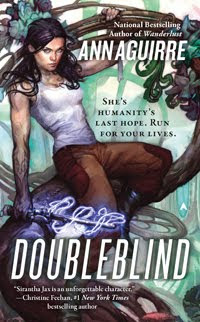
Aguirre DoubleblindColor me blissfully indifferent, but I didn’t see the connection between the heroines in the books of Asaro, Aguirre, and Landon until Ms. White pointed it out (I came across the review of DARK SPACE a few months ago). I’m bemused by the connection more than anything, especially since I read a number of the books in question within the same year. Perhaps it’s just a case of one reader’s pet peeve, or simple odd coincidence to read about similarly enhanced heroines several times in a row.

But I do wonder: Are these heroines any different from all the heroes with the same ability? After all, in the stories of the authors noted above, both male and female characters possess such talents (even if only in passing reference). Why does it become a plot device when heroines across several books share a similar ability?

My feeling is that it’s not so much of a plot device as a case of heroines playing catch up when it comes to the roles traditionally cast with heroes. In SF, authors such as de Pierres, Asaro, et. al. are simply leveling the playing field.

If male authors are writing these characters, I haven’t encountered them (but I’d love to know about such books). Which begs the question, why aren’t men writing these characters? And if they were, would it be a plot device then?

Well, I don’t know if I care about the answers to those last two questions. Let the guys do what they want. Women authors are taking charge with these types of heroines and I say go for it, no matter how many we end up with.

Joyfully yours,

Heather

Thursday, October 25, 2012

What Does It Mean To Be A Hero/Heroine In Science Fiction Romance?


In Fight Like A Girl: The Case For Real Women As Heroines In SFR, Donna S. Frelick expressed concern regarding underdeveloped kick ass heroines:


But too often, those uniquely feminine elements of their characters are overlooked, and only the “kick-ass” elements—the physical courage, the strength, the independence, the resourcefulness—are replicated in the women who populate many SFR (and urban fantasy and YA) novels. 


There’s definitely a case for well-rounded characters of either gender. I would argue that many male action heroes (in films and books) lack humanistic and even traditionally feminine qualities that would lend their characters more depth. Sometimes they come across as little more than fighting machines made of flesh. Female kick ass characters certainly aren’t immune to that. “Kick ass” is awesome, but for those characters to really shine they need more than just their kung fu skills.

Donna also points out that traditionally it’s the hero who has


…the emotional profile of the “wounded hero”, the “loner” who goes through life with shields up, unwilling to form emotional bonds with anyone until the heroine somehow reaches him. 


And that


Today very often the roles are reversed, and it’s the heroine who has relationship issues.


I can only speak to SFR since that’s been my reading focus, but I’ve certainly encountered that role reversal and I really enjoy it. Yet I’m having a hard time coming up with more than a handful of SFR heroines whose kick ass/wounded natures might be considered as overshadowing the character. (Maybe it’s a different case in UF/YA?)

Thursday, May 3, 2012

Heroines Can Be Heroes, Too

The May 4, 2012, issue of Entertainment Weekly features an interview with Joss Whedon and the cast of THE AVENGERS. At one point, the interview turned to the topic of female superheroes:

[EW:] There are a lot of female superheroes in comics, but why so few on film? Joss, you tried to make a Wonder Woman movie for several years, right?

Whedon: Studios will tell you: A woman cannot headline an action movie. After The Hunger Games they might stop telling you that a little bit. Whatever you think of the movie, it’s done a great service.

That exchange made me feel intensely emotional. I was hit with a one-two punch of a) hope at the prospect of cinematic change that THE HUNGER GAMES might usher in for female movie action stars and b) oppression upon being reminded about the toxic message that a woman can’t.

Friday, November 9, 2012

Blogging At RT Book Reviews

I'm spotlighting "Heroines At Work In Sci-Fi Romance" at the RT Book Reviews blog!

There are probably as many answers as there are heroines, but if you’re venturing into science fiction romance territory, these heroines are frequently defined in significant ways by their occupations. Each romance subgenre promises heroines with a variety of skills and traits, but one day I got to thinking about just how much sci-fi romance heroines are shaped by their occupations.

SFR heroines are some seriously busy ladies and so please join me in celebrating their industrious natures!

Joyfully yours,

Heather

Wednesday, October 14, 2015

Blogging at Heroes & Heartbreakers

My latest Heroes and Heartbreakers post is about older SFR heroines and why I love 'em! A tidbit from Space Age: Older Heroines in Sci-Fi Romance:
Older heroines in sci-fi romance are pretty scarce, but two 2015 releases made me realize how much I want more heroines in this category. Older heroines seem fresh and the life issues they face are different from those of heroines in their 20s. I enjoy getting a glimpse into a romance heroine whose life stage differs from mine. I want to be more aware of such issues through the sci-fi romance I read, so there’s a bit of cerebral appeal as well.
Joyfully yours,
Heather

Sunday, June 12, 2011

Take My Damsel In Distress—Please

Penelope Pitstop

A short while ago, I finished reading James Wallace Harris’ Are Galactic Empires the New Middle Earth? over at Auxiliary Memory (Via SF Signal). Mr. Harris examines the appeal of galactic empires in science fiction, noting that

I have grave doubts that galactic empires will ever be possible – but they are a powerful meme.  What’s so appealing about galactic empires?  The deep, spiritual response to Star Trek and Star Wars suggests almost a Jungian desire for elements of the galactic empire.  Could it be that it’s not about the potential realism of future manned exploration of the galaxy, but tuning into desires for certain kinds of experiences?

The article goes on to list a few of the common elements found in galactic empires. Mr. Harris deconstructs the galactic empire fantasy in interesting ways, but one part of it left me shaking my head in disbelief:

Gender Roles.  The 1974 Mote in God’s Eye is downright paternalistic about women, whereas thirty years later, in Risen Empire, women are liberated to be combat soldiers.  However, I think in the future where mankind has spread across the galaxy, readers still prefer strong men and beautiful women, and maybe even damsels in distress.

I didn’t think I was going to respond to the article until I read that bit about “damsels in distress.”

Here’s the comment I left:

Monday, July 6, 2009

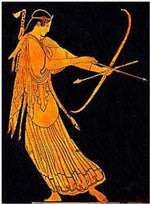
Artemis Unbound

Aspiring author Lisa Paitz Spindler, a.k.a. Danger Gal, knows how to mix sci-fi with romance. You can read an excerpt of her science fiction romance THE KINSHIP at Authonomy. She’s a member of Writers At Play as well as a book reviewer for SF Signal. Is there anything this super sister can’t do?

ArtemisWhen Heather asked me to contribute to her Parallel Universe coverage of the RWA Conference coming up in two weeks, I had to ask myself what exactly is the allure of Science Fiction Romance for me? What is it about SFR that initially drew me in and keeps me reading (and writing)? I have to admit it was Athena Andreadis' review of Star Wars over at Strange Horizons that helped me sync all the elements together, specifically this quote:

"In Mary Renault's The King Must Die, the Amazon Hippolyta agrees to a parley with Theseus, 'one king to another.' You are a queen, he corrects her. No, she replies, I'm a king like you . . . a woman king. Hippolyta becomes the irreplaceable center of Theseus' life because she is his equal. Would that Mr. Lucas had been 'radical' enough to make Padmé as powerful as Buffy, the slayer and lover of vampires. . ."

Anyone who reads my own blog probably will not be surprised that the ultimate answer to what draws me to SFR is a strong heroine on a particular kind of journey, one that includes the usual adventure plus some kind of love story. Here's why the mingling of Romance with other genres like Science Fiction, Fantasy, and Horror has created an atmosphere where the genre's already female-focused attitude enables heroines to take on new, even more imaginative, roles and to engage in a broader journey than many other heroines.

Cordelia's HonorNearly every Friday I profile such strong heroines, female characters in books and TV whose depiction subverts our common stereotypes of women. Many of these women come from Science Fiction Romances such as Soz Valdoria in Catherine Asaro's PRIMARY INVERSION, Cordelia Naismith from Lois McMaster Bujold's CORDELIA'S HONOR, Chaz Bergren in Linnea Sinclair's GABRIEL'S GHOST, and Banzai Maguire in Susan Grant's THE LEGEND OF BANZAI MAGUIRE. While it's tempting to label many of these kinds of characters just as "kick-ass chicks," because of this broader journey they are much more than that. They are a new archetype that I refer to as "Artemis Unbound."

In Greek mythology, Artemis was the daughter of Zeus and Leto and the twin sister of Apollo. In my modern interpretation, Artemis is therefore daughter of the ultimate king of the gods, and holds equal footing with her brother in the family birth order. The story of Artemis goes as so: At the age of three, Artemis asked her father, Zeus, for six wishes and he granted all of them: (1) that she remain chaste for eternity never to be confined by marriage, (2) that she have lop-eared hounds, (3) stags to lead her chariot, (4) nymphs to be her hunting companions, (5) those nymphs comprised of 60 from the river and 20 from the ocean, and (6) a silver bow and arrow like her brother's.

This paints a very interesting picture of Artemis: She wanted the freedom equal to that of her brother, as well as pretty puppies, a posse of BFFs, and cool-ass weapons to boot. This depiction of the archetypal Artemis shows up all over Science Fiction, Fantasy, and even Horror. We also recognize it as an Amazonian archetype. The merging of the treatment of this archetypal kick-ass female figure with Romance, though, liberates Artemis and her Amazonian counterparts from their chastity restrictions. Artemis chose chastity because it was the only avenue available for her to gain independence, and the Amazon legend bears some similarities to her story in that they lived apart from men, only mingling with them for childbearing purposes.

Artemis Unbound is free to engage in true intimacy, which often includes sex, in addition to all of her other freedoms. Romance, with its focus on ultimate personal actualization through emotional and physical intimacy, enables female characters to find a level of profound freedom not necessarily evident in other genres. Also, Artemis' and the Amazonian preference for the company of their girlfriends had much more to do with tickling the male fantasy of "girls gone wild" than anything else. Artemis eschewed males completely, thus taking herself out of the mating game, but Amazons oddly held up the status quo by maintaining their place as mothers. Both are defined by their relationships, or lack thereof, to men.

The new, unbound, heroines of Science Fiction Romance and Paranormal Romance get to have all the kicking-ass fun and they still get the guy or girl in the end. If it's the girl they want to partner with, it's not out of some male fantasy, but a real connection. Also, as Jennifer Crusie has pointed out about the genre in general, Romance heroines aren't made to wear giant letters on their chests, die under trains, or, in the case of Amazon Queen Penthesilea, aren't raped after death and dragged behind chariots. Historically and mythologically, the price for female empowerment has been a high one, but heroines in Romance aren't rendered that fine. Instead, they achieve a Happily Ever After.